Specifiers in the Portland Metro and the Pacific Northwest often ask for a “per-yard number” on cellular concrete the same way they ask for flowable fill or EPS geofoam. Volume Concrete does not publish a unit price for Cellular Backfill. A cubic-yard rate without volume, density, access, and testing is not a bid.
This note is a planning guide for engineers and contractors comparing cost shape, not a rate sheet. It is not a mix design and not a substitute for the engineer of record. For a job-specific quote, call (971) 219-8604.
What this comparison is (and is not)
Three lightweight-fill families show up on Portland-area geotech and utility documents:
- Cellular concrete / cellular grout — cement slurry plus preformed foam, pumped as a fluid, specified by cast density (pcf)
- Conventional CLSM / flowable fill — usually a sand–cement slurry without foam unless the spec adds it
- EPS geofoam — expanded-polystyrene blocks placed as solids, not pumped
They can all reduce load relative to compacted soil. They do not share a production method or a cost-driver list. A “$/yd³” comparison hides mobilization, access, joints, buoyancy, and testing. This site does not invent prices or bid tabs.
Three products, three cost shapes
Cellular concrete and cellular grout
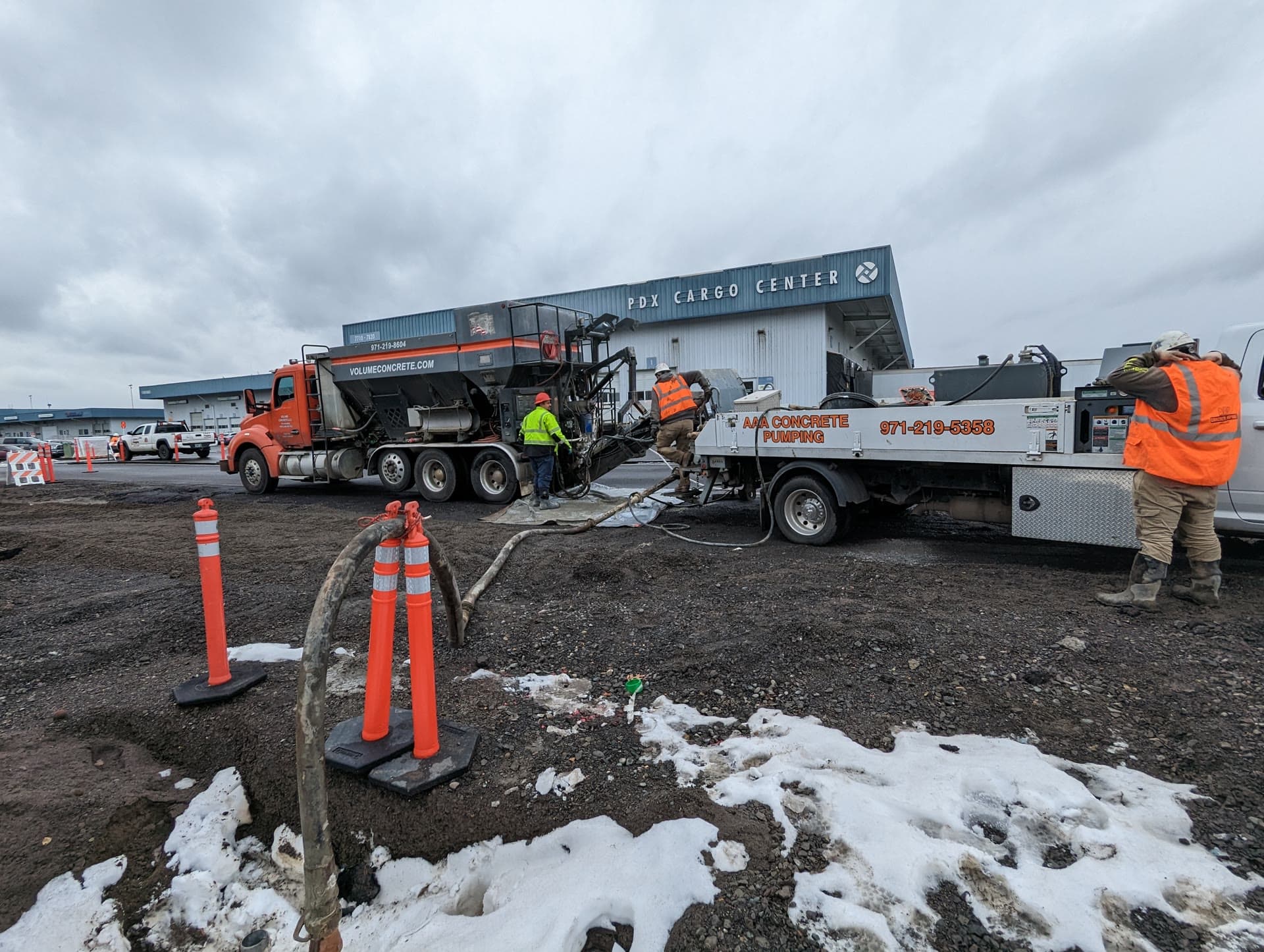
Cellular Backfill is cementitious. Production uses volumetric trucks and mobile silos. Featured mixes use Aerix foam. Cast density starts around 27 pcf and is dialed toward about 100 pcf when the engineer wants more mass or strength. A featured packet example is about 38 pcf, non-permeating, with packet maturity on the order of 104 / 144 / 180 psi at 7 / 14 / 28 days for that mix — the design Volume stands behind when that mix is ordered.
The fill is pumpable. On pipe abandonment, annular work, tanks, and irregular voids you pay to stand equipment and run hose, not to compact soil or stack blocks. Volume designs and guarantees the mix delivered to your project specs. The density explorer is an Aerix manufacturer planning reference, not a substitute for that guarantee. Related notes: cellular vs CLSM, cast density, neat vs sanded.
Conventional CLSM / flowable fill
Everyday flowable fill is still a relatively heavy cementitious slurry unless foam is written into the spec. It is often right when the job needs mass or excavatable trench backfill and does not need load reduction into the 20s–40s pcf. Cost follows ready-mix logistics more than a foam system — and leaves more dead load on the structure.
If the documents only say “flowable fill,” do not assume you are buying cellular grout. Write the density, or you will get two different products at two different costs.
EPS geofoam
Geofoam is a block product. Crews cut and stack it. It is typically far lighter than even a 27 pcf cellular fill — useful on approach fills when the design wants near-negligible dead load. It is not a Volume product, and this is not a geofoam quote. Cost shape is shop fabrication, trucking, crane or hand placement, protection, and joint detailing. You do not pump blocks down a hose into a flooded culvert, and you do not get a monolithic cementitious mass. Buoyancy is still a design item. Compare constructability, not a single yard price.
Cost drivers that actually move a Portland/PNW quote
These are the knobs Volume needs before dispatch. None of them is a published dollar.
Volume (cubic yards)
Material quantity is the first multiplier. Geometry first, then waste. Use the site calculators for full pipe, annular space, and common tank shapes — those are geometric estimates, not a ticket. Agree on optional overage for hose waste and irregular voids before the truck rolls. A 12-inch pipe and a 10-foot tank are different days even if both say “abandonment.”
Cast density and mix family
Foam, cement, and optional sand change how much paste you place per yard. A neat lightweight band (planning literature often cites roughly 20–60 pcf) is a different product family than a sanded band. Permeable and non-permeable are different chemistries, not a field toggle. Higher specified density generally means more solids and a different pump feel. Density still comes first on the ticket; strength is a second criterion only when the engineer writes an age and a psi. See neat vs sanded and permeable vs non-permeable.
Mobilization
Cellular Backfill travels with volumetric equipment and, when the job needs it, mobile silos and a pump. Greater Portland Metro ready-mix is one coverage fact; cellular jobs travel the Pacific Northwest when this product is on the ticket. Distance from home base (Estacada, city only — no plant street), number of setups, and whether the pour is one shift or several lifts all show up in the quote even if the yardage is modest. Confirm the jobsite on the service area page and the call.
Access and pump distance
Staging area, hose length, elevation change, and whether the crew can finish from outside the trench matter as much as mix design. A downtown Portland slip-liner with a long hose and tight street occupancy is not the same placement as an open lot in East County. Cellular grout is built to pump at relatively low pressure compared with heavy sand slurry — “low” is not “free,” and thin liners still need pressure awareness.
Testing and submittals
Cast-density logs at the hose are the usual field QC. Cylinders, if required, are fragile at low density: industry practice uses 3×6 in. specimens, careful handling (do not rod like normal concrete), and ASTM C495-type prep — not oven-drying before crush. Extra holds and named acceptance criteria add time. Put the method in the documents. Literature often cites ASTM C495, C796, C869, and ACI 523.1R; Volume mixes are developed in accordance with ACI 301 and ASTM C685, C1602, C150, and C1600 — standards awareness, not a certificate wall.
Water, lifts, vents, and forms
While plastic, cellular fill exerts full fluid hydrostatic pressure (cast density × depth). Typical lifts are about 4 feet unless the foam system and the engineer allow more. Flooded pipes and tanks need vents, bulkheads, and a buoyancy plan whenever specified density sits well below 62.4 pcf. Those items are engineer-of-record and means-and-methods issues; they still change crew time. See placement lifts and fluid pressure, buoyancy, pipe/tank abandonment, and annular grouting.
How to compare bids without a published price list
Ask each bidder the same questions:
- What cast density (or geofoam grade / CLSM unit weight) is in the number?
- Is foam included, or is it conventional CLSM?
- What volume and waste assumption?
- What mobilization and how many setups?
- Hose run, elevation, and street occupancy included?
- Testing — field density only, or cylinders at which ages?
- Who owns dewatering, vents, bulkheads, and lift waits?
A CLSM number that omits load reduction is not cheaper if the structure needed the light fill. A geofoam number that omits crane time and joints is not cheaper than a pumped cellular mass. Compare in-place function, then quote the product you specified.
What to collect before you call
A useful Cellular Backfill call usually includes:
- Target cast density (pcf)
- Neat vs sanded if the engineer cares about mix family
- Permeable or non-permeable
- Minimum strength only if required (and at what age)
- Volume (yd³) or geometry we can estimate
- Application — pipe, annular / slip-liner, tank, foundation, abutment, void
- Lift thickness / sequence
- Pump access — staging, hose run, elevation
- Water table / buoyancy concerns
- Testing / submittals expected
Phone for dispatch: (971) 219-8604. Hours: Mon–Fri 7–5, Sat 7–2, closed Sunday. Email billing@volumeconcrete.com if you need to send drawings.
FAQ
Why is there no published price per cubic yard?
Because volume, density, mobilization, access, pump distance, and testing change the ticket. A website rate would be wrong on the first wet void or long hose. Call (971) 219-8604 with those facts for a quote.
Is cellular concrete always cheaper than flowable fill?
No — and “cheaper per yard” is the wrong first question. Cellular grout costs what it costs to foam, mobilize, and pump a specified density. Conventional CLSM is often a heavier, simpler slurry. Use cellular when load reduction, pumpability, or a specified low density is the design reason.
How does geofoam compare on cost?
Different product, different install. Geofoam is blocks; cellular grout is pumped cementitious fill. Compare placement method, joints, buoyancy, and what the structure actually needs. Volume quotes Cellular Backfill, not EPS blocks.
What is the fastest way to get a number?
Call dispatch at (971) 219-8604 with cast density, permeable vs not, volume or geometry, and access. Use the calculators and density explorer to prepare the call. Confirm coverage on service area.
How we cover the Portland Metro and PNW
Cellular Backfill is a product line of Volume Concrete LLC. Production uses volumetric trucks and mobile silos — Type IL cement (Ash Grove Durkee OR in the featured packet), Aerix foam, sand optional. Everyday ready-mix stays in Greater Portland Metro; cellular jobs travel the Pacific Northwest. Home base is Estacada, Oregon (city only — no plant street).
Public NAP (billing / postal, not a plant street):
Volume Concrete LLC
4230 SE King Rd. #211
Milwaukie, OR 97222
(971) 219-8604
If the documents only say “lightweight fill,” write the product family, the cast density, and the access — then call for the number. Same facts sit on the calculators, density explorer, and the related notes linked above.